
R. J. Holcombe (University of Queensland, Queensland 4072, Australia; e-mail: rodh@earthsciences.uq.edu.au )
[Abstract for SGTSG Conference Halls Gap, Victoria, February 1999]

Strain Calculator provides simple, fast calculation and display of various strain and shear parameters. The displays can be copied to the clipboard for inclusion in other documents.
3-D finite strain parameters (principal stretches, strain magnitude, strain type, etc) are calculated and displayed given input either as pairs of 2-D strain ratios or as arbitrary X:Y:Z ratios.
Shear parameters for both simple shear and general shear flow, (including ellipticity, rotation component, orientation of initial and final strain axes, initial and final orientations of rotated markers) are displayed with any parameter being used as an input variable.

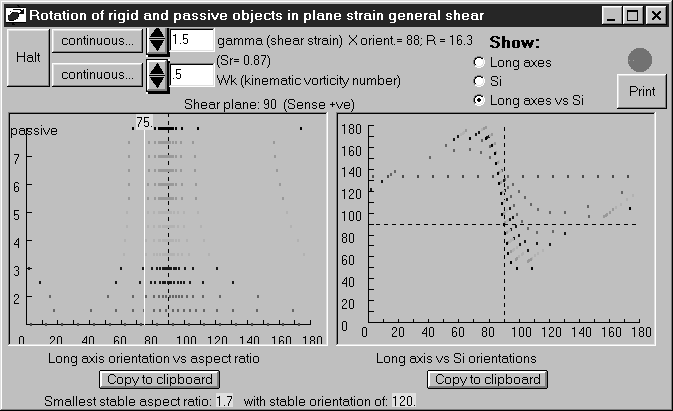
GhoshFlow models the orientation distributions produced by the rotation of rigid bodies of different aspect ratios undergoing general plane strain shear. It is based on the mathematical relationships developed by Ghosh and Ramberg (1976) and Ghosh (1993). In addition to various plots of the orientation distribution of the long axes of bodies that originally had a uniform orientation distribution, the program also calculates the hypothetical orientation distributions of internal foliations (Si) of rotated porphyroblasts. The assumption is that the original unrotated internal foliation is parallel to the shear/flattening plane. In particular, plots of the orientation of Long Axes vs Si orientation have been found to produce a particularly sensitive vorticity and shear strain gauge (for situations fitting the model constraints). In such plots, the pattern of distribution paths for a range of different aspect ratio objects is very distinctive under any given combination of shear strain and vorticity number. The shear strain component is given by the final orientation of internal foliation within equant objects (whose rotation rate is solely a function of the shear strain rate and independent of the vorticity number). For any given shear strain the distribution pattern changes greatly with change in vorticity number. The strength of using such plots as a vorticity gauge is that only the pattern for different aspect ratios need be recognised, not the complete distribution, hence the gauge is not dependent on the initially orientation distribution.
Strain Calculator and GhoshFlow are programs written for running on PCs under Windows95 or Windows NT. They are available free for downloading from the UQ Earth Sciences Software Development site at: http//www.earthsciences.uq.edu.au/~rodh/software/
References:
Ghosh, S.K. and Ramberg, H. 1976. Reorientation of inclusions by combination of pure shear and simple shear. Tectonophysics, 34, 1-70.
Ghosh, S.K. 1993. Structural Geology: fundamentals and modern developments. Pergamon, 598p.

Return to:
× Holcombe Home Page ;  U.Q. Home Page
  Earth Sciences Home Page